“The problem is that incremental steps along the way can be excused as not changing the outcome. But taken together, these steps can pave the way for the rule of law - and our system of checks and balances - to break entirely”.
-Attorney at a settling firm, Interview for this report
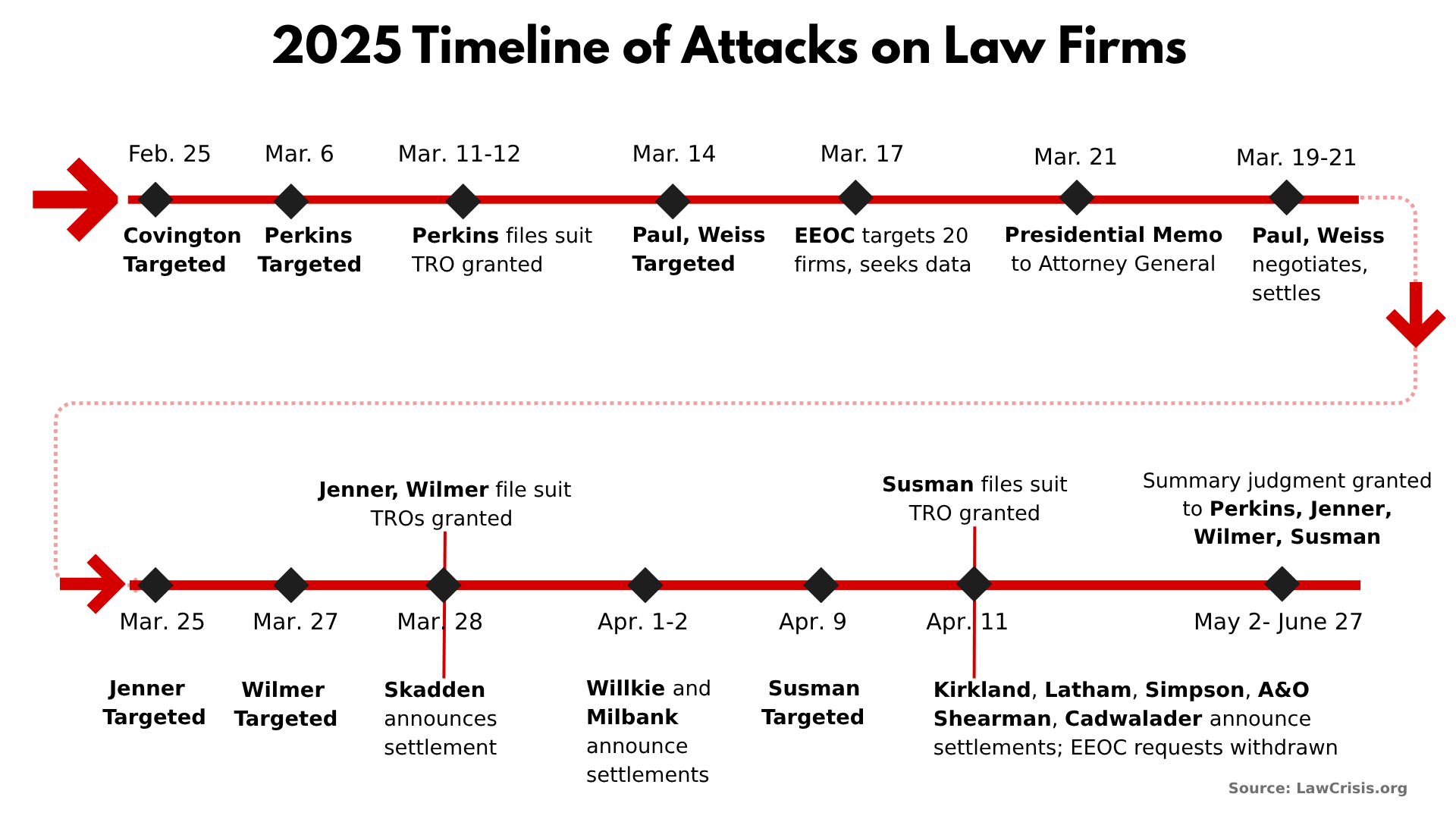
Starting in February 2025, the incoming Trump administration used Executive Orders, Presidential Memoranda to the D.O.J., and Equal Employment Opportunity Commission (EEOC) requests to threaten numerous law firms’ security clearances, government contracts, and access to federal courthouses. Firms were targeted not for illegal conduct but rather for representing clients and causes disfavored by the President and for employing lawyers he disliked. In response to this pressure, four firms filed lawsuits, and nine others negotiated deals with the administration.
Between October 2025 and March 2026, the author conducted interviews with twenty-nine current and former partners and associates from law firms that responded to the administration’s pressure campaign in varying ways. The interviews were structured using prepared questionnaires but also developed into a more flexible format with open-ended questions to determine how lawyers and firms reacted to the administration’s pressure campaign. Most interviewees spoke on condition of anonymity.
Research for this report also included a detailed examination of relevant Executive Orders, court filings, judicial rulings, White House statements, and related press coverage, as well as internal firm correspondence.
The Report’s Findings
Fear significantly magnifies perception of risk
“Some firms negotiated with the administration to secure agreements even absent any Executive Order targeting them. It was clearly profit and client driven, but it revealed a level of fear that has intimidated institutions throughout the past year.”
- Former senior D.O.J. official
Collective action can help effectively counter government pressure campaigns
Dozens of attorneys resigned from law firms that settled – some did so quietly, while others did so publicly. Many openly shared their resignation letters, explaining their commitments to preserving and fighting for the rule of law. These departures amounted to a form of collective action that radiated across the legal industry, the press, and the larger public.
Business leaders have a crucial stake in upholding the rule of law
“Instead of caving, these firms could have demonstrated how to stand up and challenge the President’s bullying. This would have shown other sectors and industries, universities, media, philanthropy, and business, how to do the same.”
-Lawyer involved in collective action
The Report’s Recommendations
Prepare in advance to counter pressure campaigns magnified by fear
“Our firm’s response failed to meet the moment in part because we didn’t have clear red lines. It’s important to document where your red lines are in advance before the pressure starts rising.”
-Attorney at one of the settling firms
Seek to build coalitions and act collectively
Collaborative efforts between firms and individual lawyers can oppose the isolation that the administration’s pressure campaigns have taken advantage of. When one firm or individual is targeted, solidarity and public support can reduce the impact of fear and bolster resolve.
Defend the free market system and uphold the rule of law
The free market system and the rule of law must be maintained for firms to succeed in the long term, and acquiescence to the administration’s demands can weaken the independence and integrity of major firms, losing clients, partners, and public support.